
How to Shock Your Pool: When, Which Type and How
Shocking is one of the most useful tools in pool care, as long as you do it at the right time and the right way.
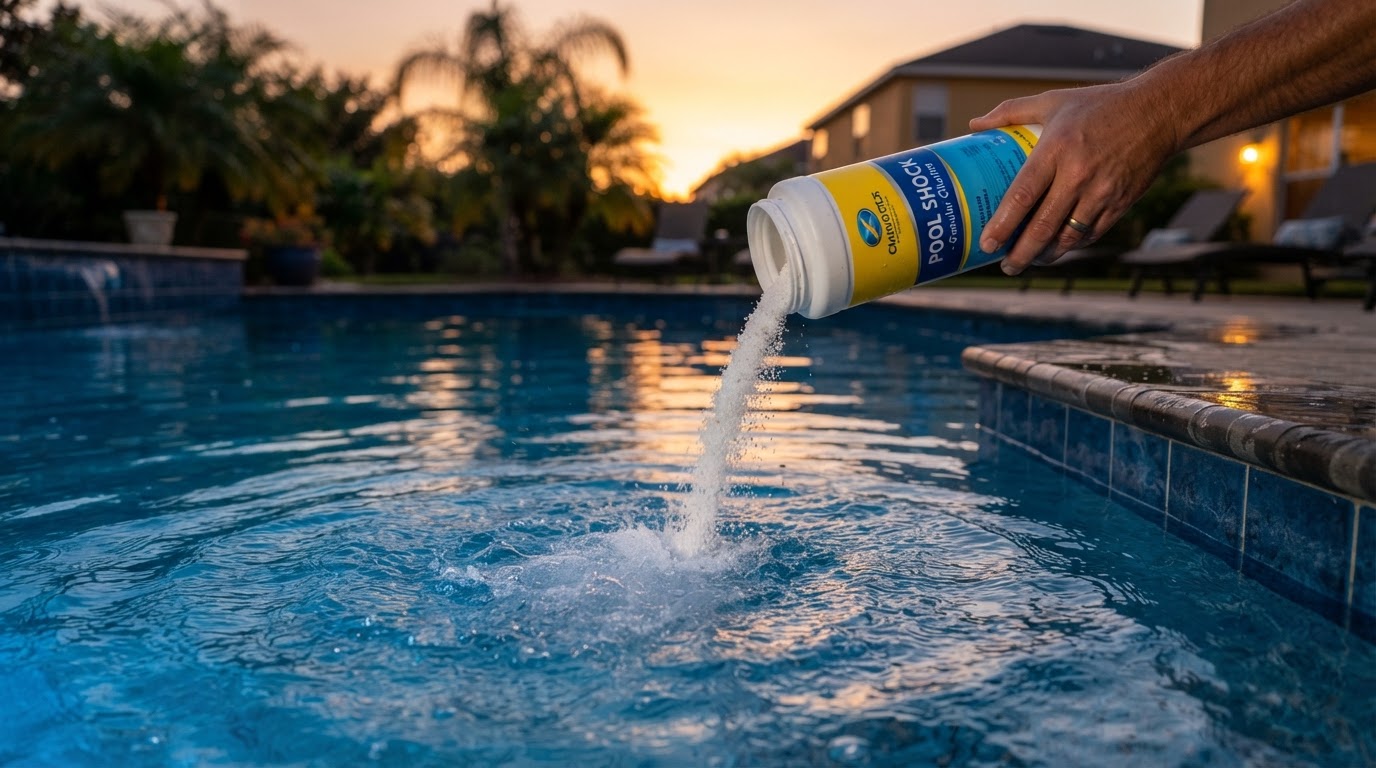
Shocking means adding a large dose of sanitizer to quickly raise chlorine levels. It breaks down used-up chlorine compounds that cause a strong chlorine smell and red eyes, kills bacteria and knocks out algae. Shock after heavy rain, a pool party, when water turns cloudy or green, or when chlorine has dropped too low. Test and balance pH first, shock in the evening with the pump running, and wait until chlorine returns to a normal range before swimming.
What shocking actually does
As chlorine works, some of it combines with sweat, oils and other contaminants to form chloramines. These are what cause that strong chlorine smell and irritated eyes. A pool that smells strongly of chlorine usually needs more chlorine, not less. Shocking breaks down chloramines, restores free chlorine and wipes out algae and bacteria before they take hold.
When to shock your pool
- After heavy rain or a storm
- After a pool party or heavy swimmer use
- When the water looks cloudy or starts turning green
- When there is a strong chlorine smell
- When free chlorine tests low
- During long stretches of hot, sunny weather
- When opening the pool for the season
Types of pool shock
| Type | Good to know |
|---|---|
| Calcium hypochlorite | Strong and widely used. Adds calcium and should be dissolved in water before adding |
| Dichlor | Dissolves quickly and contains stabilizer, which builds up over time if used often |
| Liquid chlorine | Fast acting and adds no calcium or stabilizer |
| Non-chlorine shock | Breaks down contaminants and lets you swim sooner, but does not kill algae |
The right type depends on your water. A water test tells you which is best, for example if your calcium or stabilizer is already high.
Not sure which shock or how much your pool needs? Bring a sample to our Alpharetta store at 2900 Holcomb Bridge Rd for a free computerized water test.
How to shock your pool
- Test your water so you know your chlorine and pH levels.
- Balance pH first. Chlorine works best when pH is in range.
- Work out the dose from your pool's volume and the product label.
- Shock in the evening so the sun does not burn off the chlorine before it works.
- With the pump running, add the shock as the label directs. Pre-dissolve granular shock in a bucket of water, adding shock to water, never water to shock.
- Spread it around the pool, away from the skimmer, and brush the walls and floor.
- Keep the pump running and retest the next day before swimming.
Safety first
Never mix different pool chemicals, including different types of chlorine. Never add calcium hypochlorite to a feeder or skimmer that holds chlorine tablets. Always follow the label, add chemicals to water and wear gloves and eye protection.
Mistakes that waste chlorine
- Shocking when pH is too high, which makes chlorine much less effective.
- Shocking in midday sun.
- Under-dosing, which leaves algae and chloramines behind.
- Using a stabilized shock too often, which builds up stabilizer.
- Turning the pump off afterwards.
Frequently asked questions
Get the dose right
Bring a water sample to Pool Supply Atlanta, 2900 Holcomb Bridge Rd, Alpharetta, GA 30022 for a free computerized test. Open Monday to Friday 9am to 5pm and Saturday 9am to 4pm. Serving Alpharetta, Roswell, Milton, Johns Creek and Sandy Springs. Questions? Call 678-691-6124.
Related Pool Articles
The Ultimate Atlanta Spring Pool Opening Checklist (2026 Edition)
Spring weather in North Georgia comes early! Here is your step-by-step checklist to open your Alpharetta or Roswell pool crystal clear.
How to Clear Green Pool Water Fast in Georgia Summer Heat
Hot Georgia sun and sudden thunderstorms can turn a pool green overnight. Follow our proven 4-step green-to-clean recovery plan.