
How Many Gallons Is My Pool? Easy Formulas and Calculator
Every chemical dose starts with one number. Here is how to get it right.
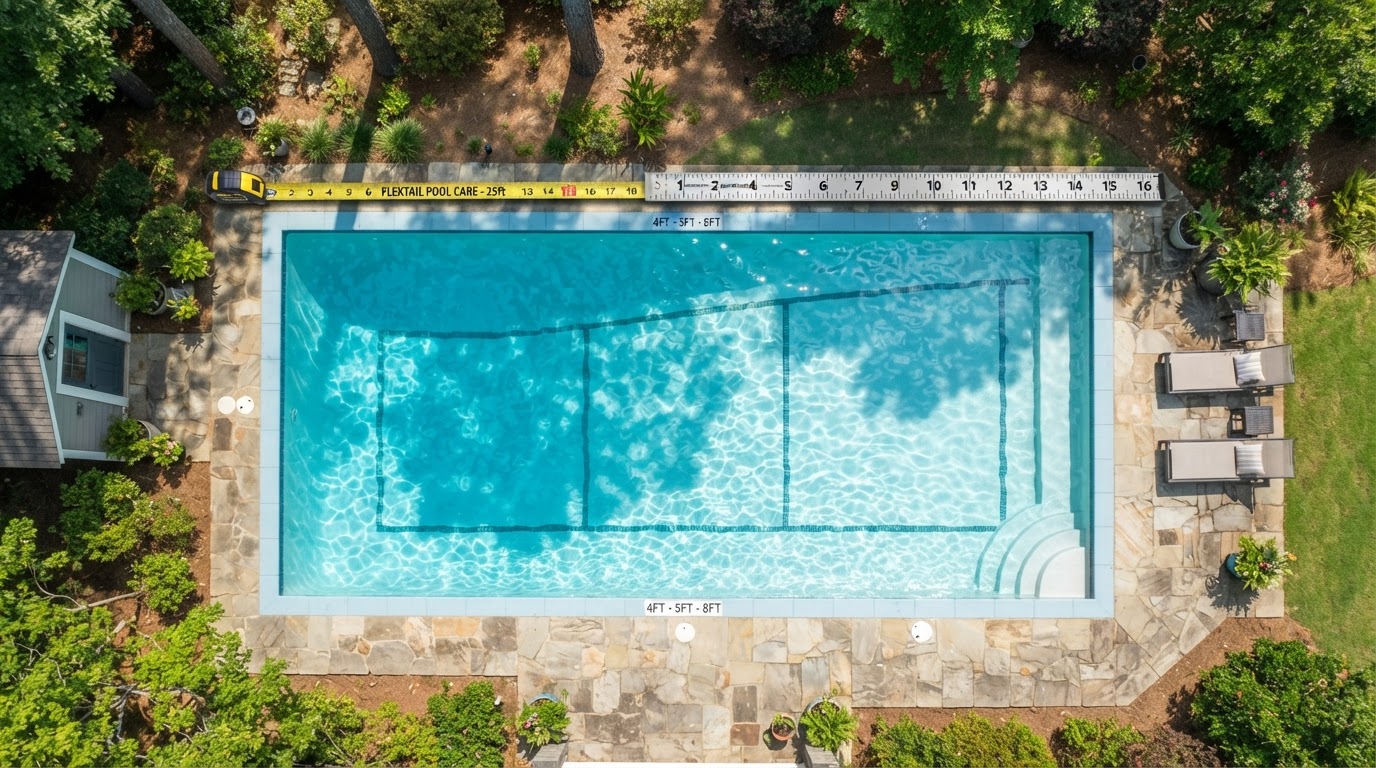
To find your pool's volume, multiply length by width by average depth (all in feet), then multiply by 7.5 for a rectangular pool or 5.9 for a round or oval pool. Average depth is the shallow end depth plus the deep end depth, divided by two. The quickest way is to use the free Pool Calculator on our website.
Why your pool's volume matters
Chemical directions are almost always based on gallons. If you guess your volume, every dose is a guess too. Too little and the chemical does not work. Too much and you waste product, throw your water out of balance or risk damaging your finish and equipment. Your volume also tells you how long to run your pump so all the water gets filtered each day.
How to work it out
- Measure the length and width of your pool in feet. For round pools, measure the diameter.
- Measure the depth at the shallow end and the deep end in feet.
- Work out the average depth: add the shallow and deep depths together and divide by two.
- Use the formula for your pool shape in the table below.
Formulas by pool shape
| Pool shape | Formula |
|---|---|
| Rectangle or square | Length x Width x Average depth x 7.5 |
| Round | Diameter x Diameter x Average depth x 5.9 |
| Oval | Length x Width x Average depth x 5.9 |
| Kidney or freeform | Split the pool into simple shapes, work out each one and add them together |
Worked examples
- Rectangle: 16 ft x 32 ft, 3.5 ft shallow end, 7 ft deep end. Average depth = 5.25 ft. 16 x 32 x 5.25 x 7.5 = about 20,160 gallons.
- Round: 24 ft diameter, 4 ft deep throughout. 24 x 24 x 4 x 5.9 = about 13,600 gallons.
- Oval: 15 ft x 30 ft, 4.5 ft average depth. 15 x 30 x 4.5 x 5.9 = about 11,950 gallons.
Skip the math. Our free Pool Calculator works out your pool's volume for you in seconds.
Tips for an accurate number
- Measure at the waterline, not the outside edge of the deck.
- If your deep end has a steep drop rather than a gradual slope, average the depth for each section separately and add them together.
- Write your volume down somewhere handy, like on the lid of your chemical storage or in your phone.
- If you are unsure, it is better to underestimate slightly and add more chemical after retesting than to overdose.
Using your volume for pump run time
Your pump should run long enough to move your pool's full volume of water through the filter at least once a day. Divide your pool's gallons by your pump's flow rate in gallons per minute to find how many minutes it takes to turn over the water once. Variable-speed pumps run longer at lower speeds, so check your pump's settings or manual.
Put it to use
Once you know your gallons, chemical dosing gets much easier. Read our pool chemical basics guide to learn what each chemical does, and bring a sample in for a free water test to confirm exactly what your pool needs.
Frequently asked questions
Know your number, then test your water
Use our free Pool Calculator, then bring a water sample to Pool Supply Atlanta, 2900 Holcomb Bridge Rd, Alpharetta, GA 30022 for a free computerized test. Open Monday to Friday 9am to 5pm and Saturday 9am to 4pm. Serving Alpharetta, Roswell, Milton, Johns Creek and Sandy Springs.
Related Pool Articles
The Ultimate Atlanta Spring Pool Opening Checklist (2026 Edition)
Spring weather in North Georgia comes early! Here is your step-by-step checklist to open your Alpharetta or Roswell pool crystal clear.
How to Clear Green Pool Water Fast in Georgia Summer Heat
Hot Georgia sun and sudden thunderstorms can turn a pool green overnight. Follow our proven 4-step green-to-clean recovery plan.